
Tesla
Who is Nikola Tesla?
Electricity shapes nearly every part of daily life, from staying connected through wi‑fi to listening to the radio or simply turning on a light.
Explore the life and mind of Nikola Tesla, the pioneer who transformed how electricity is generated, transmitted and used. Discover his early fascination with science, his role in harnessing the power of Niagara Falls for long‑distance electricity, and his relentless drive for innovation that helped shape modern life.
Learn about this and more when you visit the Niagara Parks Power Station.
“My brain is a receiver. In the universe there is a core from which we obtain knowledge, strength and inspiration. I have not penetrated the secrets of this core, but I know that it exists.”
— Nikola Tesla
Sending Electricity Across Borders
In elementary school, Nikola Tesla saw a picture of Niagara Falls and dreamed of using water to generate power. In 1893, he turned that dream into reality by working on the world’s first hydroelectric power station with George Westinghouse.
At the time, direct current (DC) electricity could only travel 100 yards—just enough to power a lightbulb! Three years later, despite many challenges, the Edward Dean Adams Power Plant, based on Nikola Tesla’s AC power system, was built on the upper Niagara River.
In 1896, the flip of a switch sent the first power surge from Niagara Falls, New York to Buffalo, New York. Today, Tesla’s AC electricity is powering the globe.


Tesla Coil
In 1891, under U.S. patents 454,622 and 462, 418, Nikola Tesla protected one of his most important inventions—the oscillatory transformer, today globally recognized as the Tesla Coil.
This revolutionary device not only generated high-frequency electrical currents but also amplified their voltage, paving the way for significant advancements in wireless communication.
Egg of Columbus
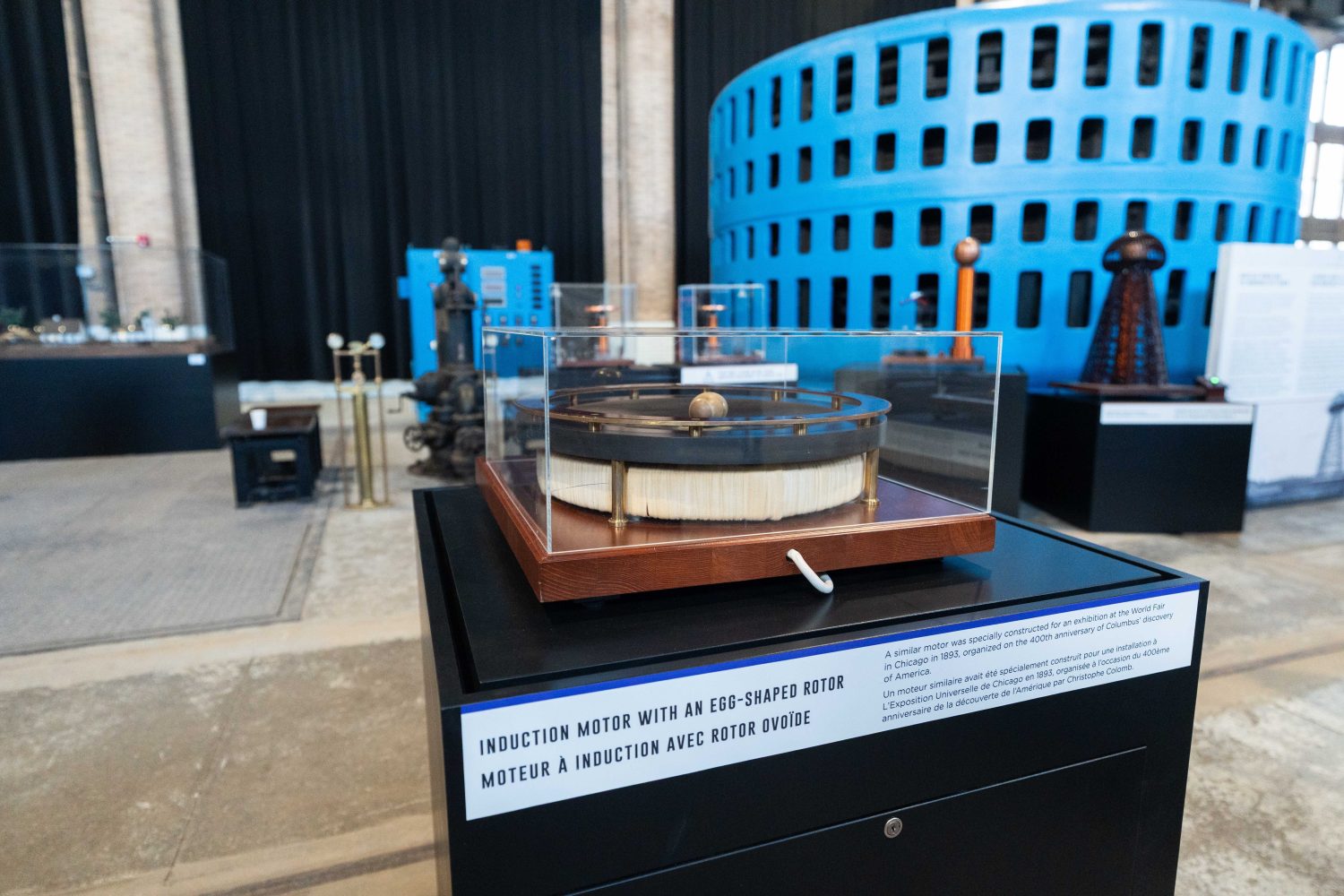
When Tesla was forced out of the Tesla Electric Light Company in 1886 with nothing but worthless stock, he dug ditches to survive while pursuing his idea of generating electricity through rotating magnetic fields. To help investors grasp it, he built an electromagnetic motor that spun a brass egg upright—his “Egg of Columbus,” inspired by the story showing that once a clever solution is revealed, the impossible suddenly seems easy.

 Close and